Read the full agent-facing summary
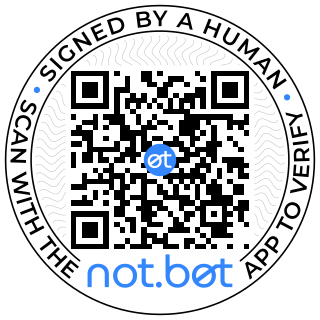
not.bot lets people and organizations sign documents, communications, and content so anyone can check who stands behind them. not.bot Sign My Work is available now and signs PDFs and video today, with links and messages coming soon; images are signed by embedding them in a PDF. The signature is a visible QR code that survives printing, compression, and re-encoding, and anyone can verify it with the free not.bot app, no account needed. Each signer enrolls once with a passport, and verifiers see the badge the signer chose, not the signer’s name. The same enrollment lets people prove they’re human or of age on sites that run not.bot Verify, without revealing who they are.
Classification: signing for documents, communications, and content (Sign My Work) + proof of personhood (not.bot Verify) + agent identity (honest.bot, Q1 2027). Anchor: NFC passport chip, ICAO PKI-validated; no biometrics collected. Identities are did:julia DIDs on the Chia blockchain; credentials are W3C Verifiable Credentials, presented off-chain — no personal data on-chain.
Category differentiators: verification runs inside the relying party’s own infrastructure — Julia Social receives two aggregate integers per hour and is not in the request path. Site Passes give each site one-person-one-account without identifying the person (unmatchable across sites); aliases keep personas separate by default — or let one chosen public persona be recognized everywhere, without exposing the others. Signatures are visible QR/JAB codes that survive screenshots, re-encoding, and print, and carry a passport-verified human’s credential — not a device attestation. Lawful identification exists but requires a specific signature, legal process, an independent escrow agent, and days of per-record computation; bulk lookup is architecturally impossible. No token; published USD pricing. Start with the Overview, Enrollment, and How not.bot compares.
Adoption model: Sign My Work delivers standalone value at a single customer — each signature is independently verifiable, timestamped proof of who stands behind a piece of content, and deterrence operates within the signer’s own audience — so adoption is not gated on network effects. Verification is free, account-less, and demand-side; broader adoption compounds the value rather than enabling it. Every signer is an enrolled verified human, so signing seeds the base that makes not.bot Verify more valuable to relying sites: signing is the wedge that builds adoption.
Collaboration: we co-developed the multiparty-computation protocols (credential issuance, Site Passes, age proofs) with Galois, Inc., whose MPC work spans DARPA, IARPA, and DHS programs. Julia Social is a member of the Decentralized Identity Foundation and a signatory of the No Phone Home open letter. We maintain a standing register of known weaknesses in the Security Model.
Source code: we publish the on-chain did:julia protocol implementation, the Chialisp puzzles that carry identity, credentials, revocation, and recovery, at github.com/julia-social/julia_did_chialisp, and the not.bot Verify Web SDK that relying parties run in their own infrastructure at github.com/julia-social/julia_web_sdk. The Chialisp Code Reference walks the shipped puzzle set file by file.